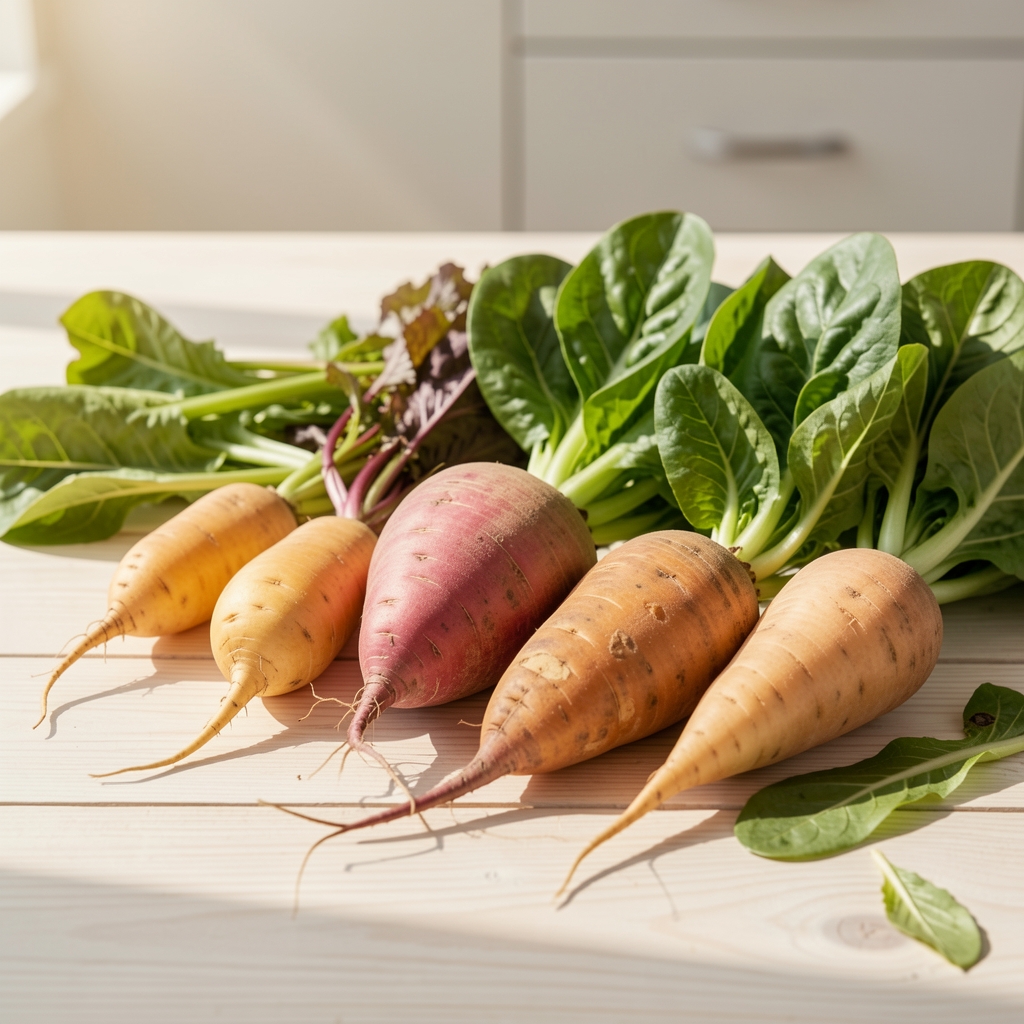
In the long run of a food journal, the turning of seasons becomes visible as a nutritional record. The plate in October is a different object from the plate in April — not just in its contents, but in its texture, weight, and the kind of fullness it produces. There is a nutritional logic to this seasonal variation, one that has largely been set aside in the era of year-round availability, but which reasserts itself when cooking is organised around what the current season offers.
The Autumn Plate as a Nutritional Object
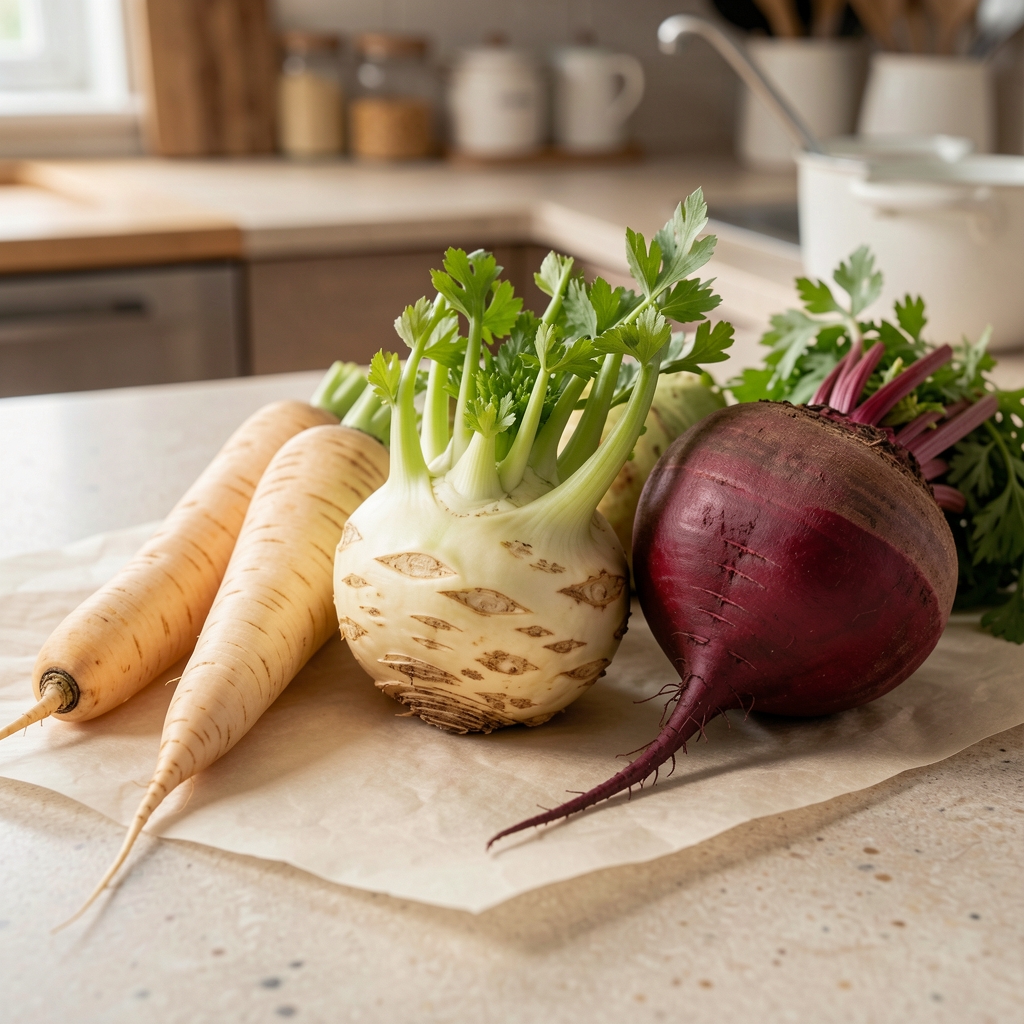
Autumn in England brings a particular set of vegetables to the foreground: kale, chard, cavolo nero, leeks, parsnips, celeriac, squash, beetroot, swede, and a range of root vegetables whose dense texture and high fibre content make them nutritionally distinct from the lighter salad crops of summer. This shift in the composition of available produce has a direct effect on the nutritional balance of the weekly plate — if the cook is attending to it.
The fibre content of autumn root vegetables and brassicas contributes to a sense of fullness between meals that summer produce, with its lighter water-rich profile, does not replicate to the same degree. A bowl of roasted celeriac and kale with lentils produces a different satiety response than a salad of cucumber and tomato — not because one is superior, but because they address the body's autumn context differently. Nutritional awareness of seasonal produce is not about hierarchy; it is about fit.
From the perspective of diet and weight, the autumn plate is interesting precisely because it offers density without reliance on processed food. The caloric density of roasted root vegetables, whole grains, and legumes assembled into a meal sits at a level that supports sustained energy through the shorter days, while the fibre and water content of the same ingredients supports portion awareness in a way that ultra-processed alternatives do not.
Plant-Based Meals and Weight Balance Through Autumn
The relationship between plant-based eating and gradual weight change is one of the most consistently supported associations in published nutrition literature. This does not mean that plant-based eating is a single practice with a single profile; it encompasses a wide range of food choices, from whole-food approaches centred on vegetables, legumes, and whole grains, to patterns that rely heavily on plant-based convenience products with refined ingredient lists.
The autumn season provides a particular argument for the whole-food end of this spectrum. When the week's plant-based meals are built around seasonal produce — a leek and white bean soup, a roasted squash with quinoa, a cavolo nero stir-through with pasta — the ingredient list tends to be short, the fibre content high, and the food preparation process itself a form of portion awareness. Each of these meals requires decisions: how much squash, how many beans, how generous the grain portion. These decisions, made with fresh ingredients, engage the cook's attention in a way that heating a packaged product does not.
Nutritional balance across an autumn week also involves fruit — less prominent than summer, but present in a different form. Apples, pears, quince, and late plums offer the sweetness of summer's soft fruits with a fibre and polyphenol profile suited to the season. Their inclusion in the weekly rhythm of meals and snacks supports dietary variety without requiring anything more complex than a bowl on the counter.
"The autumn plate is interesting precisely because it offers density without reliance on processed food."
Nutritional Balance and the Weekly Food Rhythm
The concept of nutritional balance is frequently reduced to the idea of proportion — a certain ratio of macronutrients, a specific number of fruit and vegetable portions per day. This reduction is understandable from a public health communication perspective, but it strips away something important: the temporal dimension of how food is actually eaten. Nutritional balance across a week is not the same as nutritional balance in a single meal, and the weekly food rhythm is where the meaningful patterns reside.
What the autumn calendar offers is a natural scaffolding for this weekly rhythm. If the cook is working with seasonal produce, the week's meals acquire a degree of variety that is built into the supply: the market or box scheme delivers a range of vegetables that requires creative engagement. The result is a week that naturally contains more variety than a meal plan built from a fixed grocery list, and dietary variety — the breadth of different foods consumed — is itself an independently observed nutritional indicator.
The evidence-informed approach to understanding seasonal produce and weight does not claim that eating autumn vegetables in themselves produces weight change. What it observes is a structural association: people who organise their eating around seasonal whole foods tend to have diets with higher fibre content, greater dietary variety, and lower processed food reliance — all of which are separately associated with gradual weight stability in published dietary research.
Cooking as a Nutritional Practice
There is a dimension of autumn cooking that is rarely addressed in nutritional discussions: the act of preparation itself. Roasting a tray of root vegetables — choosing the combination, cutting the pieces, seasoning, watching the caramelisation — is a form of mindful engagement with food that has its own relationship to eating behaviour. The cook who has spent twenty minutes preparing a meal approaches it differently than the person who has removed a container from a microwave.
Mindful eating — the practice of attending to the sensory experience and hunger cues of a meal — is more naturally accessible when the meal was assembled from whole ingredients. The knowledge of what went into a dish supports a different quality of attention at the table. This is not a moral argument; it is an observational one. The relationship between cooking from scratch and weight awareness is partly physiological (whole food ingredients, fibre, satiety) and partly attentional (engagement with the food before, during, and after eating).
Autumn cooking, with its slow-roasted squashes, long-simmered soups, and warming grain bowls, has a pace that supports this attentional quality. The autumn kitchen is not the same as the summer kitchen of quick salads and cold plates. It demands presence: checking the oven, adjusting the stock, deciding when the leeks are sufficiently softened. That demand, modest as it is, keeps the cook in contact with the food in a way that contributes to the quality of attention brought to the meal itself.
- 01 Autumn root vegetables and brassicas offer high fibre content that supports a sense of fullness between meals.
- 02 Seasonal produce naturally increases dietary variety, an independently observed marker in nutritional research.
- 03 Whole-food plant-based meals built around seasonal ingredients tend to require more active portion decisions than convenience alternatives.
- 04 The act of seasonal cooking sustains attentional engagement with food, which supports the conditions for mindful eating.
A Record of the Autumn Week
The food journal for a single autumn week, kept without intervention, tends to tell a particular story. Monday: a lentil soup assembled from the previous week's remaining vegetables. Tuesday: a convenience lunch, noted without judgment. Wednesday: a market run producing a celeriac, two bunches of kale, a bag of chestnuts. Thursday: the celeriac roasted, the kale wilted with garlic, the chestnuts stirred through. Friday: leftovers from Thursday, which is itself a nutritional observation — the autumn kitchen tends toward meals that multiply.
What this record surfaces is not a perfect week of nutritional compliance. It surfaces a pattern with real texture: the convenience Tuesday sits alongside the market Wednesday, and neither cancels the other. The week's nutritional balance is not determined by its worst day but by the accumulated rhythm of its seven days. The autumn table, with its dense and varied produce, supports a kind of nutritional gravity — a tendency toward whole food cooking that reasserts itself even when individual days depart from it.
This is the nutritionist's perspective on seasonal produce and weight: not as a corrective, but as a context. The seasonal calendar creates conditions — in the market, in the kitchen, on the plate — that are more or less supportive of the kind of eating patterns associated with gradual weight stability. The cook who follows the autumn season is not following a programme. They are working with a structure that was embedded in food culture long before nutrition science named it.